- evaluating the full cost of Your Trip
This extension is an offshoot of my great love for Disney parks. I’ve been to all 6 global locations and consider myself a Parks Nerd.
Read the PRD
Context
Disney vacation pricing is notoriously opaque. Park tickets, hotel tier, dining plan, Lightning Lane, special events, souvenirs & snacks, and add-ons are all priced and sold separately at different points in the booking flow. This all makes budgeting difficult to comprehend accurately when it’s time to decide whether a trip is affordable and what options might tip the scales in or out of favor. The advertised price is rarely close to what a family actually ends up paying.
The problem
People book a trip and make a commitment to their family or travel group based on a partial number, then discover the real cost incrementally, add-on by add-on, after they're already invested. I wanted a tool that would front-load that complexity by surfacing the true total cost before the emotional investment has been made, not after when it might be too heartbreaking to back out.
I don’t believe Disney makes a calculated effort to hide the true cost. The simple fact is that not all costs a family might incur on a vacation can be determined up front; and of course Disney is not responsible for estimating a family’s discretionary spending while on vacation. People like me who have experience going to the parks, know what the true cost can be. We know how to use split stays, travel dates, and passholder discounts to keep costs in check. For first-time planners wondering if a trip is even affordable, a more realistic breakdown of costs is imperative to managing expectations. So too would an understanding of when specific payments are due and how much will need to be set aside each month if the plan is to save up steadily ahead of the trip.
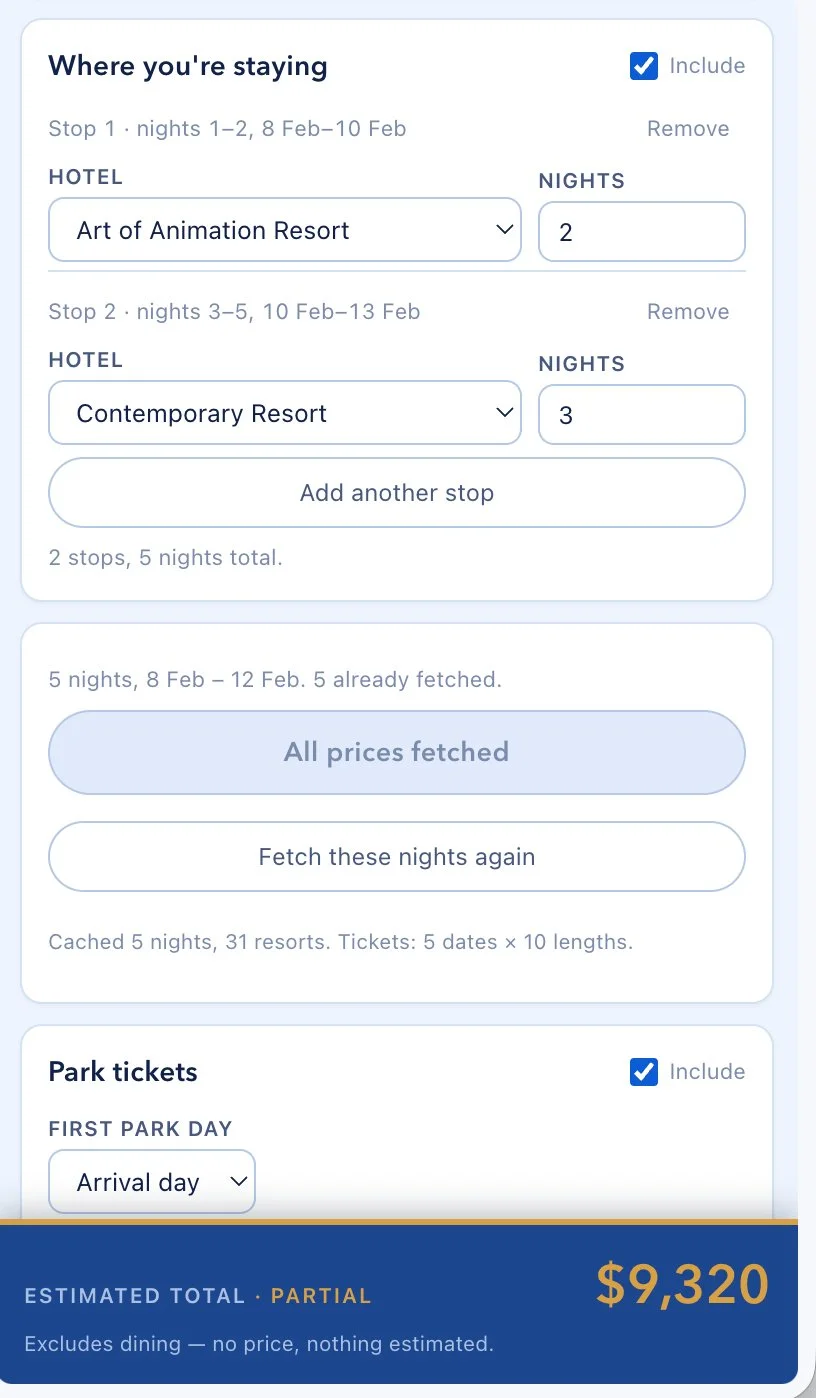
Disney’s website offers a hotel-to-hotel comparison tool, but it doesn't incorporate split stays, which is one of the biggest cost-saving mechanisms frequent visitors use to keep hotel costs at a reasonable average nightly rate.
Decisions & tradeoffs
Disney’s annual passes, dining plans, and character dining prices are set annually, so it’s simple to pull them periodically rather than per session - and store them in-app for fast retrieval, but it means the prices need to be monitored for updates by the app maintainer.
Hotel and ticket pricing are the most dynamically priced offerings and need to be generated in real time, per session for the information to be useful.
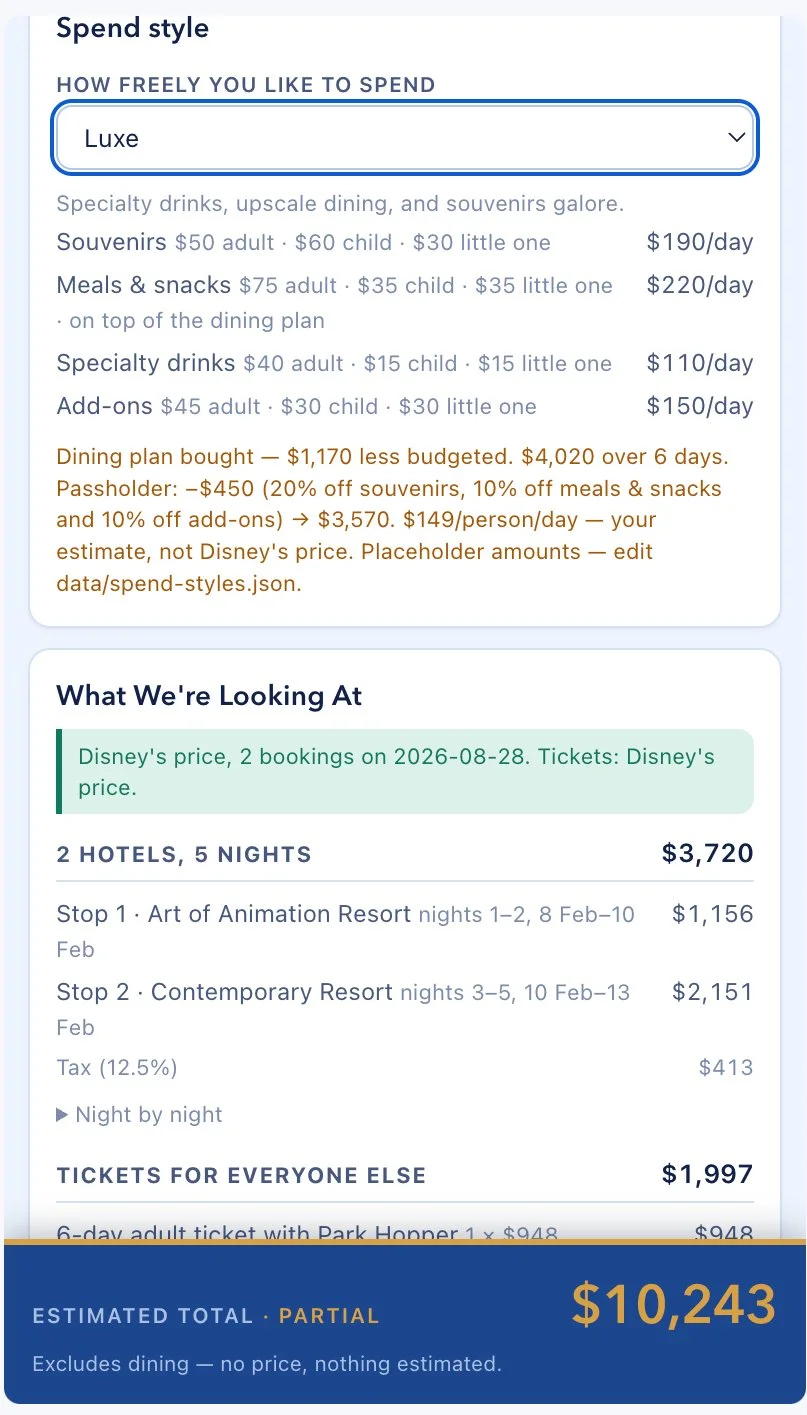
Discretionary spending is the most arbitrary category. Tiers and subcategories can be managed in a configuration file.
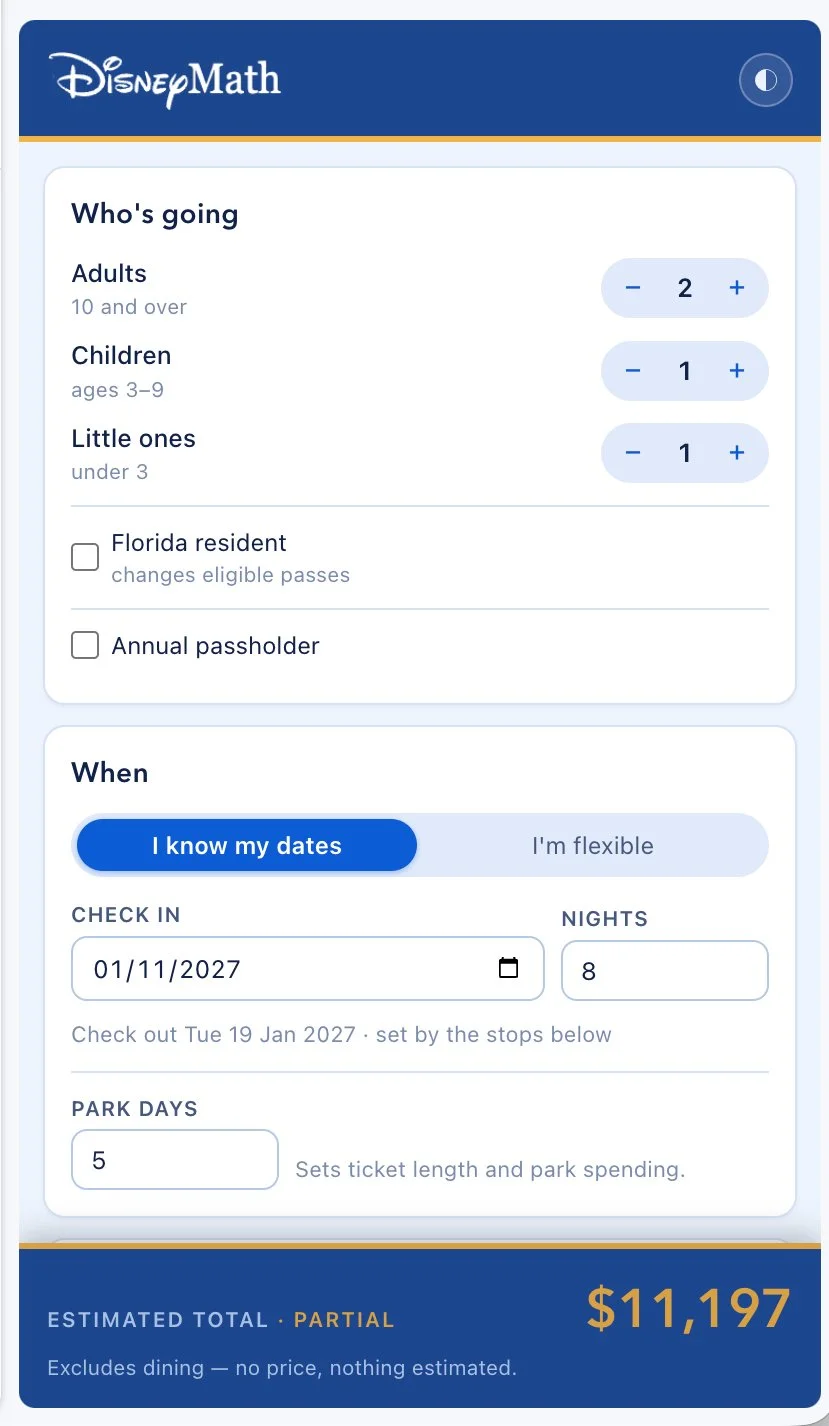
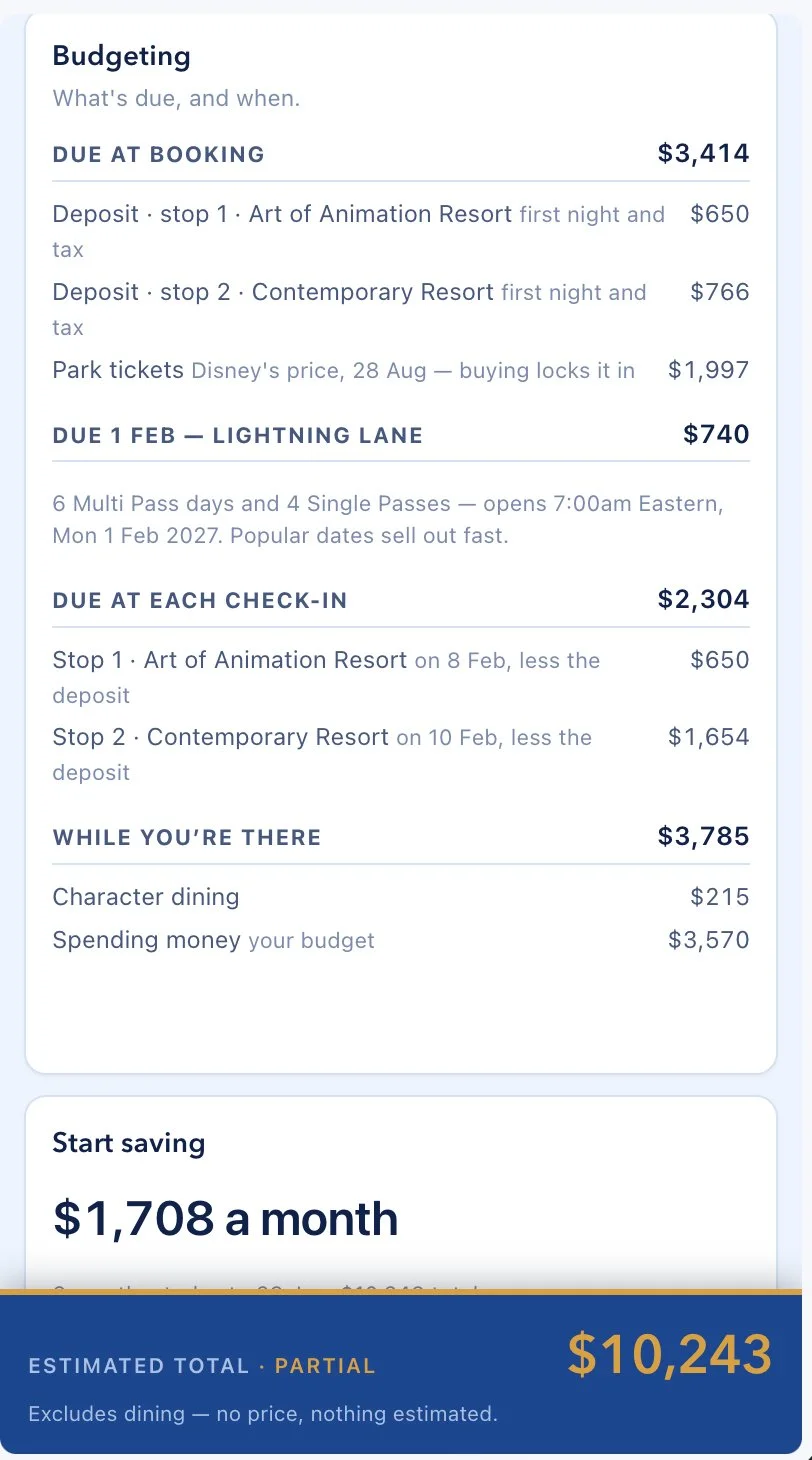
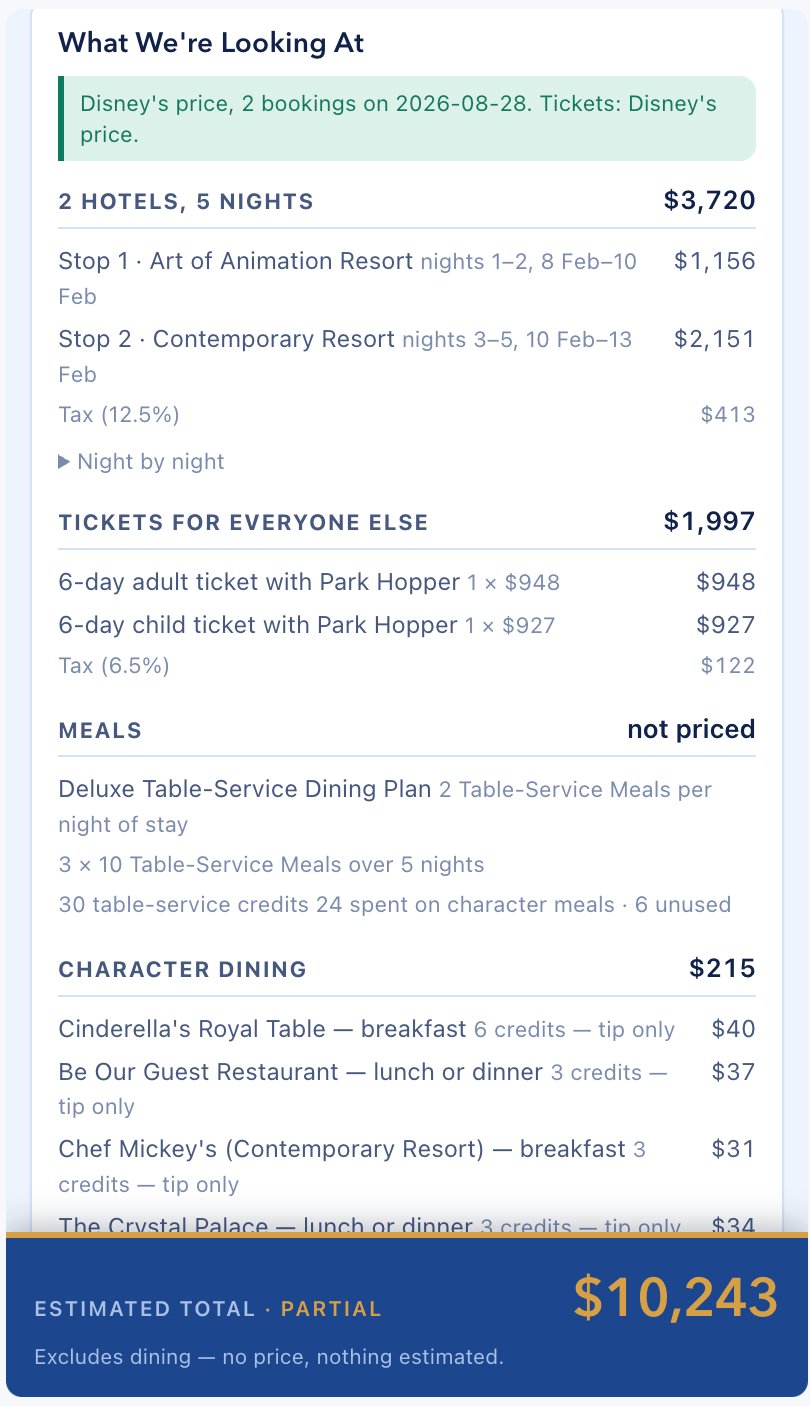
The order of options is designed to emulate the way a person would think about their trip - hotel first, then park tickets - with an option to consider an annual pass - then character dining and special events, then discretionary spending. Finally, a budget timeline shows when payments would be due for different aspects of the trip.
The audience for the trip is people considering a vacation. It’s not a budgeting tool per se. As such, it doesn’t need to be 100% accurate, only realistic.
It makes sense to focus on one location - Walt Disney World - for the MVP to determine product market fit before expanding to the other 5 global resorts, all of which have completely different options and features for hotels, tickets & passes, dining, budgeting, and booking.
Intended Outcome
To go beyond MVP, and to expand to all 6 locations, the UX needs tightening up.
Affiliation with a licensed Disney travel agent would be a natural fit for this tool and could funnel customers to the agent to complete booking and explore ways to bring costs down even further.
Having an Agent manage settings and configs for the extension would also ensure data integrity, providing greater user confidence in the cost estimates.
Risks & Open Questions
Does knowing the “true” cost up front deter booking or does seeing the savings from “tips & tricks” like dining plans, annual pass-holder savings, and split stays provide a “perceived value” incentive?
Customer research would be key. The full costs of a Disney vacation is high. What would make knowing the true cost up front worth committing to the trip?
Possible questions/incentive:
Would interest free financing on the entire cost - or a link out to financing services like Affirm or klarna - incentivize booking if the “true” cost were known?
How does the presentation of costs impact the user’s likelihood to continue with the booking? Option A: Cheaper options suggested by the tool up front; or Option B: Discovering it themselves through the tool’s options with brief explanations (e.g. meal plan, annual pass)
How does the budget presentation impact the likelihood to continue with booking?
How does travel agent affiliation impact the likelihood to continue with booking? Option A: a strong CTA and messaging vs Option B: tool is provided without any messaging to work with the travel agent and user is left to make the decision based on the inherent complexity?
My assumption is that “hidden” costs are perceived negatively while the “true” costs presented by the app, with realistic due dates and options to find discounts and lowest rates, would be perceived positively. A third scenario that needs to be validated is whether lower up front costs tend to stick in people’s minds as being the “cost” of the trip and the additional costs that pile up are ignored.
The biggest bet here is that seeing the monthly breakdown and the timing of costs due bring affordability within reach while keeping the cost realistic.
nb: some time around September 15 (after this extension was created) Disney began beta testing a vacation planning tool on its WDW website that helps families identify the best resort and time or year for their trip. So far it doesn’t include the other pricing features that are part of this extension, but it’s great to see Disney providing vacation planners with more options to help drive that all important decision!
Details
How does it work?
The extension acts like a browser for the most part, doing what you would do if you were searching for hotels and park tickets and just presenting the information it finds in its own search. For “extras” budgeting, it makes estimations based on configurable spend profiles (no frills, balanced, or luxe). For annual passes, dining plans, and lightning lanes, Disney typically increases prices by a fixed % annually, so we use past years’ data to create a forecast for the coming year which can be manually maintained when real numbers are available.
For this prototype, there’s not much more to it.
What’s included?
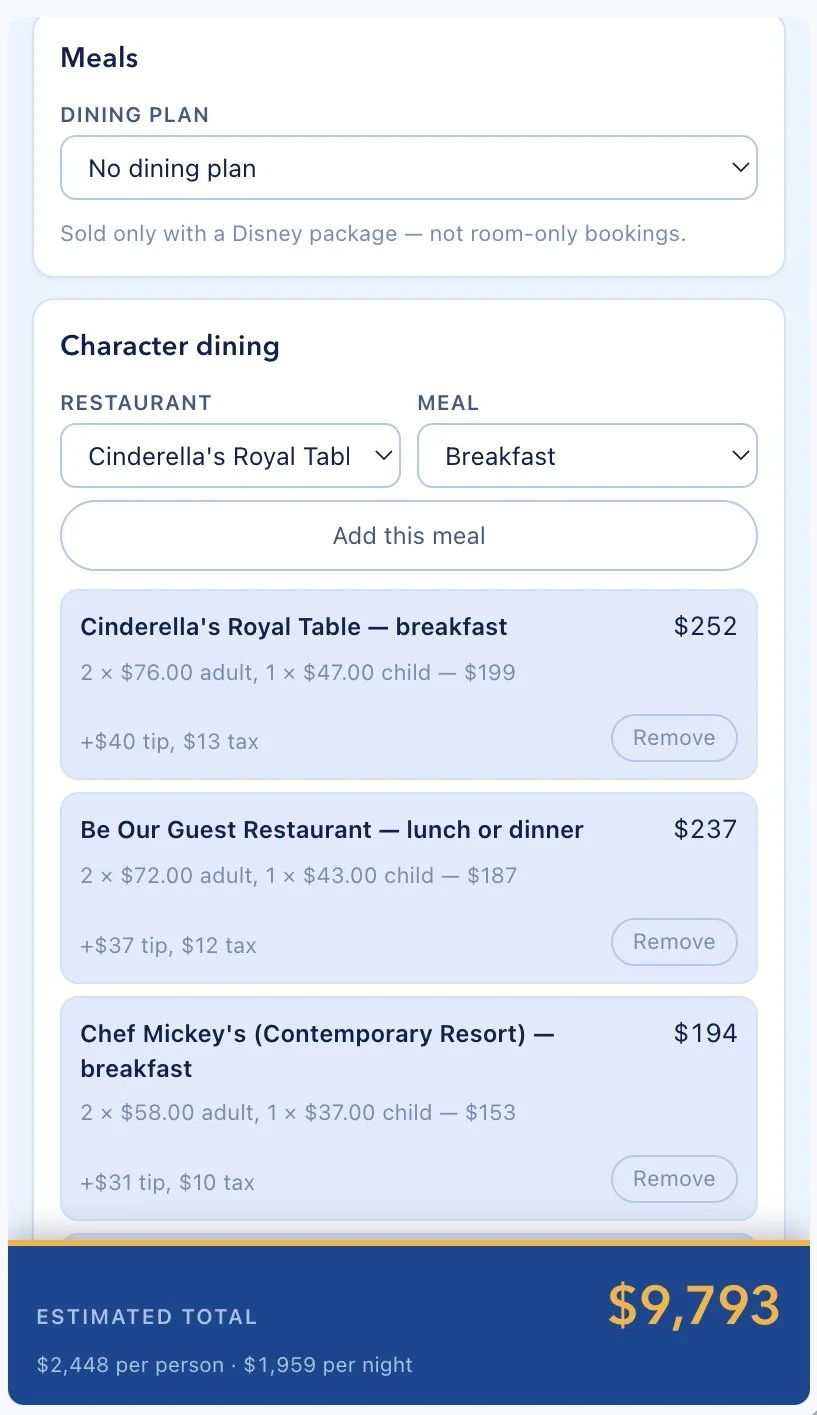
Hotels - with split stay option and date/resort adjustments to find optimal prices
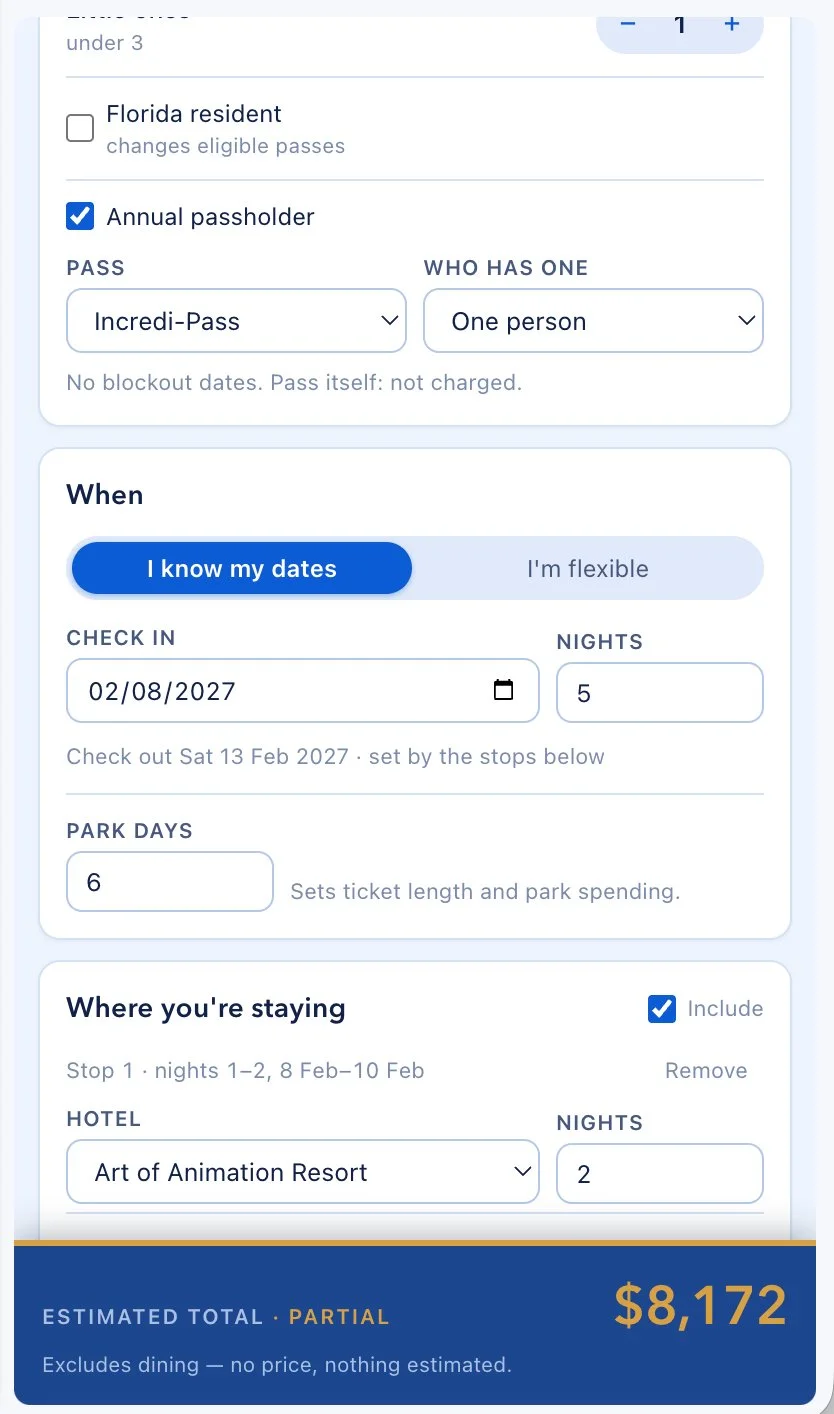
Park tickets with the option to specify an annual passholder
Annual pass holder math (ability to see if it’s worth having someone buy an annual pass)
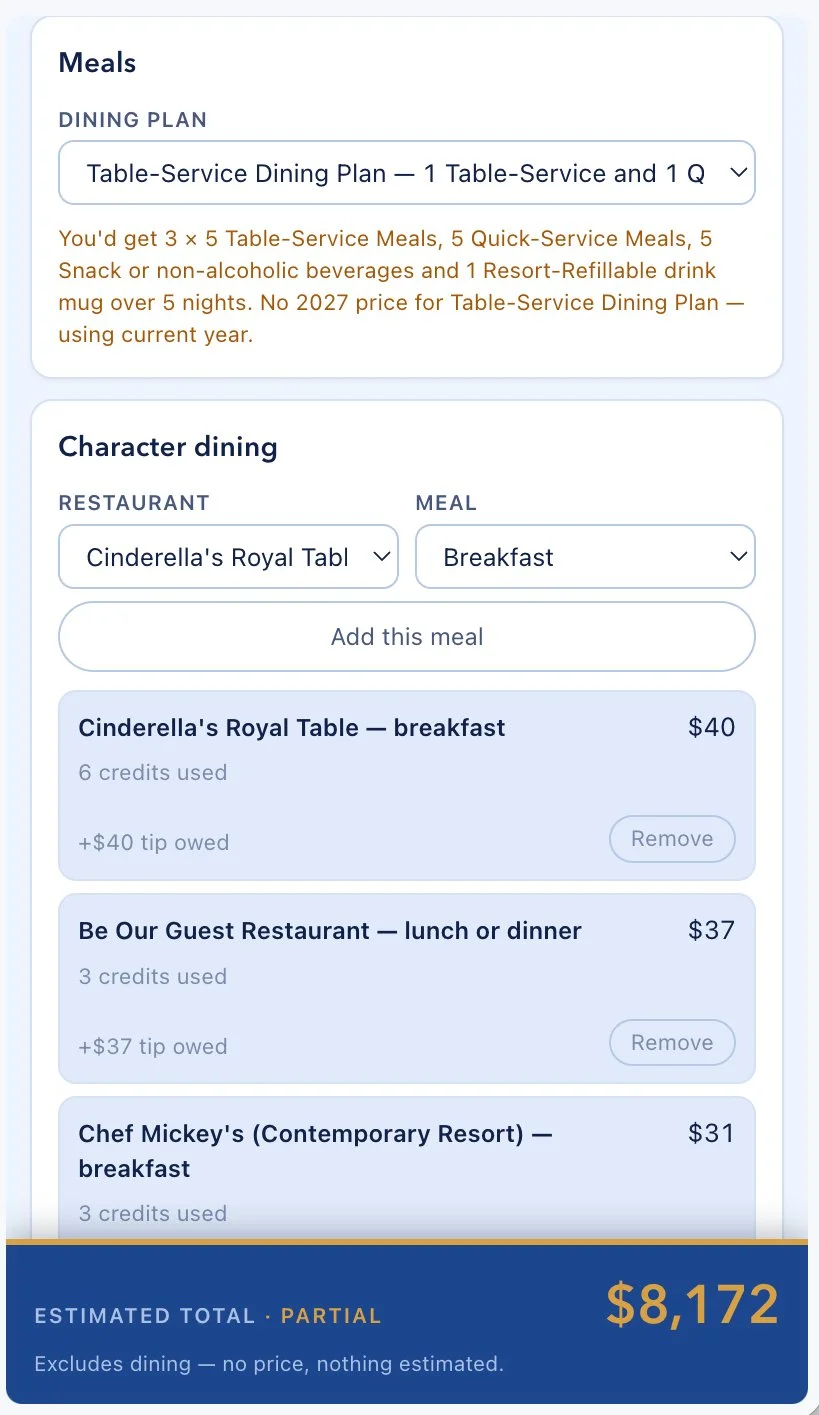
Dining plan
Character dining
Daily spending budget
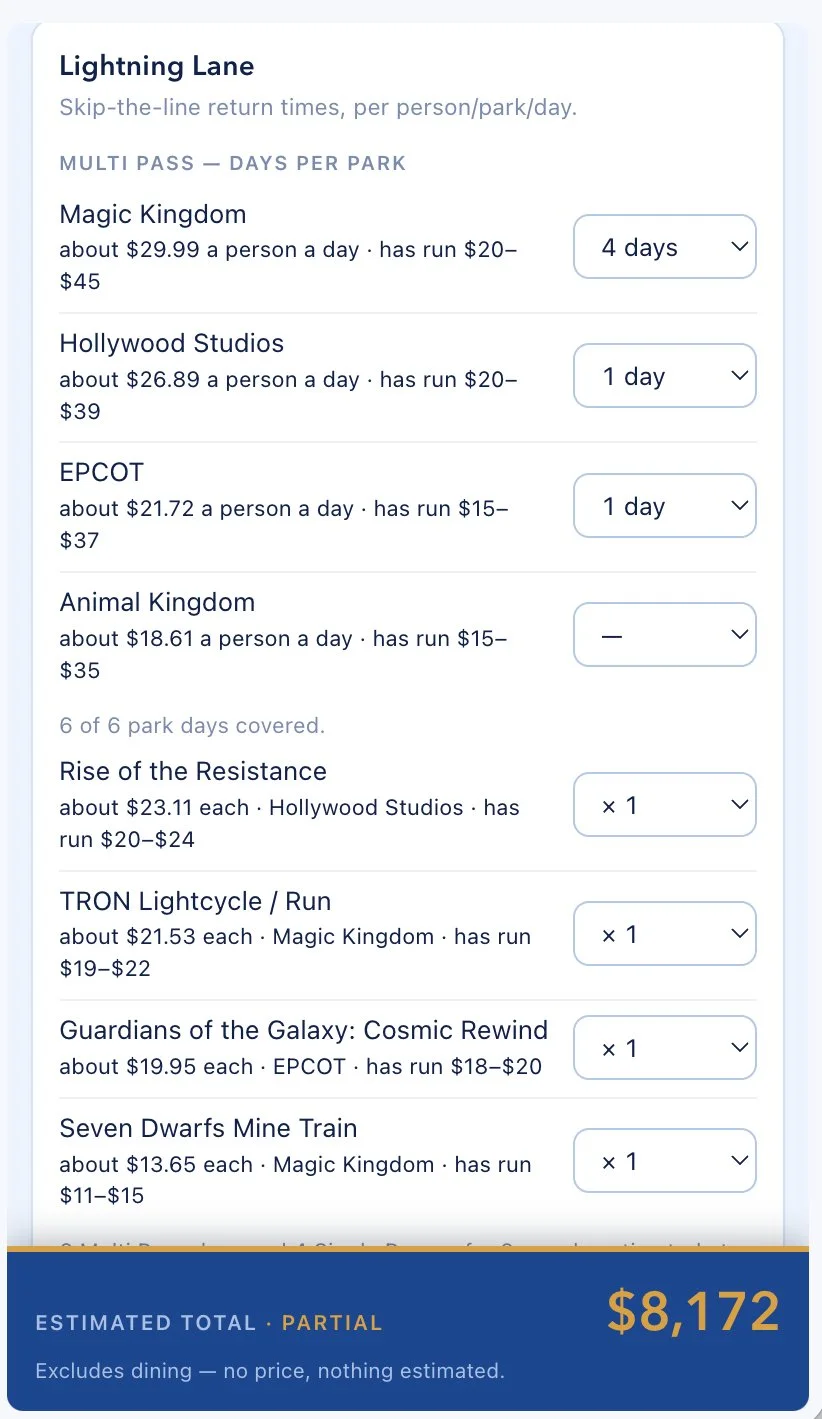
Lightning lanes
Special event ticketing
Budgeting - what’s due and when and how much to save each month leading up to the trip.
disclaimer: this extension uses a mix of real time and forecasted data (extrapolated from historic data but manually configurable). It was designed and developed for personal noodling and is not affiliated with the Walt Disney company. Prices quoted by the app are intended to give a reasonable picture of total trip cost and do not constitute any guarantee of actual, final expenditure.